Richard Zhu

PSPL Biased Filter Study

A lab research report on a dual-layer biased filter for secondary species emissions from electric-thruster beam targets.

2023UCLA PSPL, Los AngelesCOMSOLElectric thrustersParticle tracing
PSPL Biased Filter Study artifact

Proof surface

Public proof, private boundary, and status for this work object.
ClaimPublic proofPrivate boundaryStatus
Biased-filter conceptArchival-cleaned PSPL report and extracted COMSOL/MATLAB figures.Original lab folders and editable source files are not published.Archival cleaned
Simulation workflowPage shows electrostatic field, particle tracing, phase diagram, and SolidWorks model figures.Only report-ready figures are public.Public figure set

Biased-filter concept

Public proof
Archival-cleaned PSPL report and extracted COMSOL/MATLAB figures.
Private boundary
Original lab folders and editable source files are not published.
Status
Archival cleaned

Simulation workflow

Public proof
Page shows electrostatic field, particle tracing, phase diagram, and SolidWorks model figures.
Private boundary
Only report-ready figures are public.
Status
Public figure set

Research frame

The PSPL project studied a practical measurement problem in electric-thruster ground testing. When an ion beam strikes chamber hardware or a beam target, secondary species emissions can contaminate particle-density and current measurements. The report proposed a biased electrostatic filter: a dual-layer charged grid placed near the beam target to suppress lower-energy secondary particles while letting the higher-energy incident beam pass with minimal disruption.

2charged grid layers used as the core biased-filter concept
COMSOLelectrostatics and charged-particle tracing for field and trajectory simulation
MATLABparameter sweeps, potential profiles, and phase-diagram style summaries
SolidWorksfinal beam-target model translated from the simulation geometry

What was modeled

The model treated the vacuum chamber as a grounded cylindrical domain and placed charged tungsten-wire grids between the beam target and the region where secondary particles would rebound. The design variables were intentionally physical: wires per layer, layer count, parallel separation, vertical clearance, wire radius, and applied potential.

  1. define chamber and beam target geometry
  2. parameterize wire-grid design
  3. solve electrostatic field
  4. trace secondary particle trajectories
  5. summarize geometry-performance tradeoffs

The report moved through staged simulations. Early runs validated the field shape in simple geometries. Later stages compared vertical clearance, parallel separation, voltage-sign ordering, and particle tracing behavior. The central engineering question was not whether a charged grid can create a field. It was which geometry gives useful suppression without becoming impossible to manufacture or disruptive to the test environment.

Simulation evidence

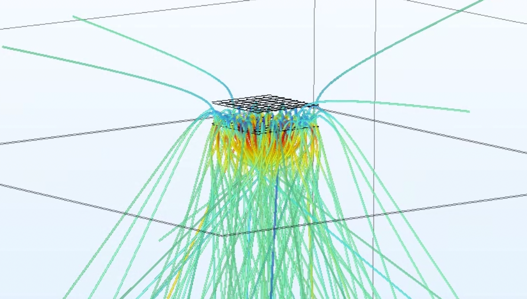
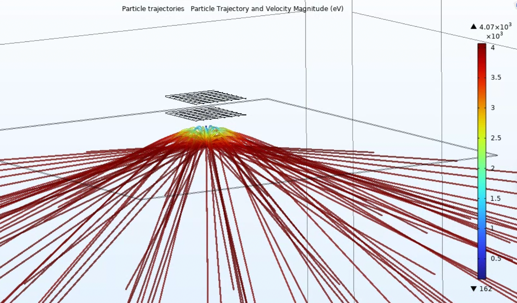
These are the figures that carry the project: trajectory traces, field visualization, a parameter-sweep phase diagram, and the manufacturable SolidWorks model. They come from the PSPL report itself rather than from a console capture.

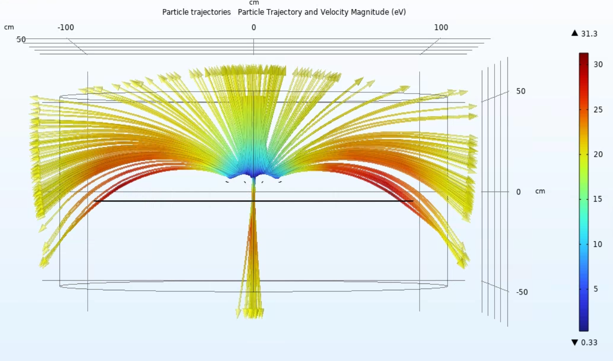
PSPL positron beam particle trajectory traces from the biased filter report
Figure 19: positron-beam trajectory tests, with the upper comparisons around 420 eV and the lower comparison around 10 eV.
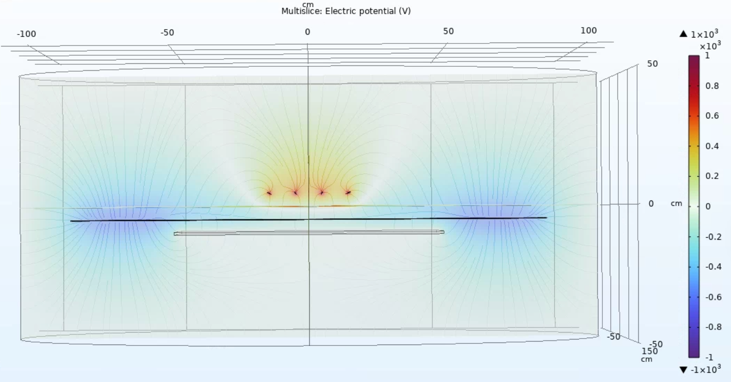
Electrostatic field visualization for the PSPL biased filter geometry
Figure 21: electrostatic field visualization after introducing a grounded plate near the filter geometry.
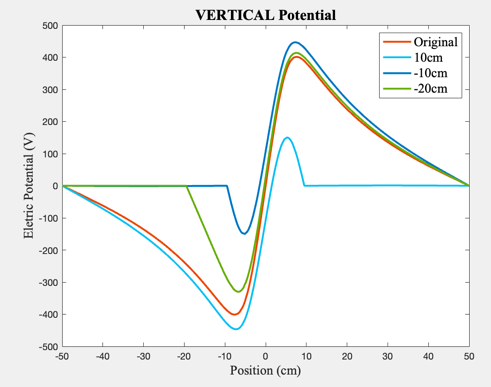
Vertical potential line plot comparing original and shifted plate cases
Vertical potential comparison for original, +10 cm, -10 cm, and -20 cm grounded-plate positions.
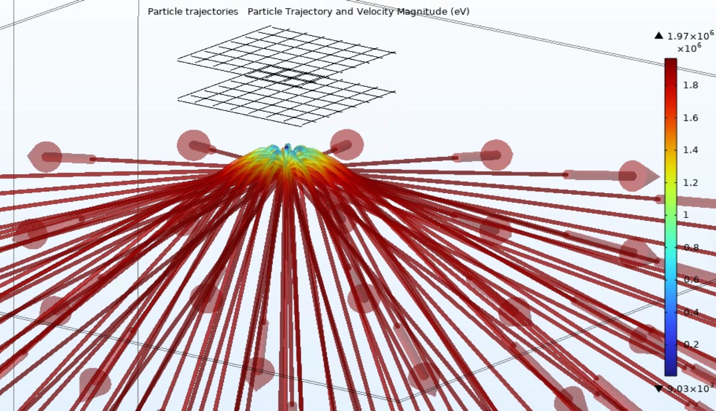
Hemispherical 10 eV electron trajectories from the beam target surface
Figure 22: 300 hemispherically released 10 eV electrons from the beam-target surface, used to test whether the filter blocks secondary species under a more realistic release model.
EMI+ cation trajectory simulation at 10 eV
Figure 23 left: EMI+ cation test at 10 eV, a heavier charged species case.
IM- anion trajectory simulation at 10 eV
Figure 23 right: IM- anion test at 10 eV, paired with the cation case to stress the charge and mass assumptions.
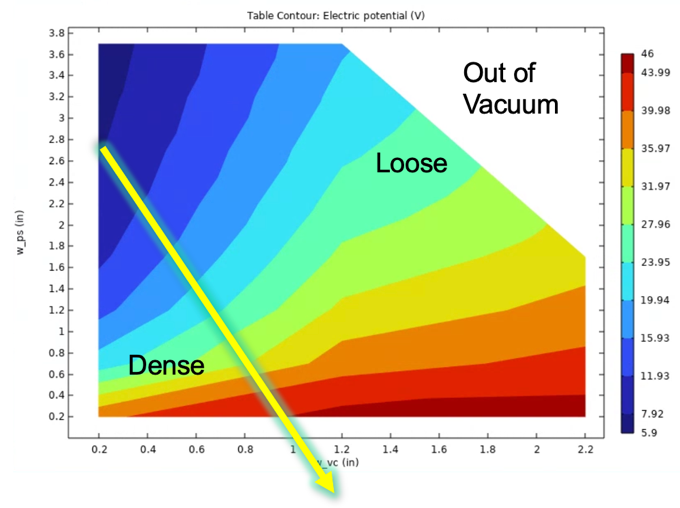
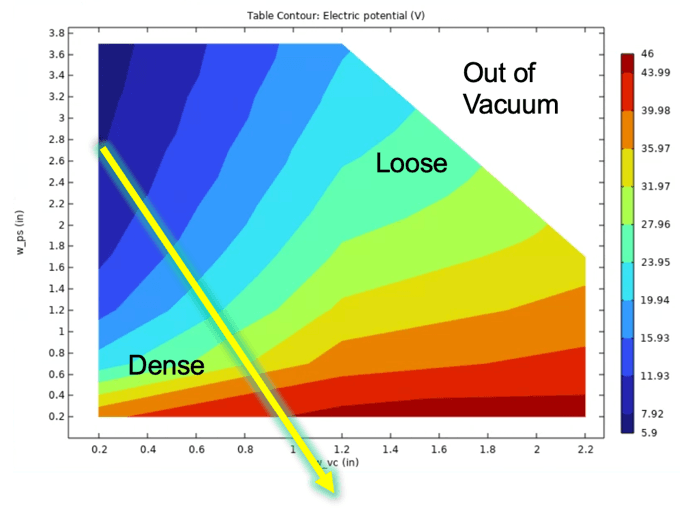
PSPL phase diagram for parallel separation and vertical clearance parameter sweep
Figure 25: phase diagram summarizing how parallel separation and vertical clearance affect maximum potential and practical geometry choice.
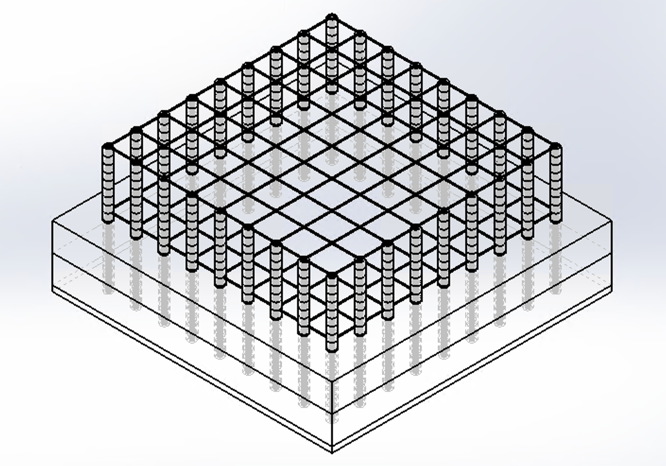
SolidWorks model of the PSPL biased filter and beam target assembly
Figure 27: SolidWorks model translating the simulation geometry into a beam-target and biased-filter assembly.

Design comparison

Biased-filter design comparison from the PSPL report.
Design choiceResultInterpretation
Alternating polarityWeak central potential in several geometries.Neighboring layers partially cancel the field where suppression is needed.
Separated polarityStronger useful potential.Grouping same-sign layers preserves a more meaningful barrier near the target.
Smaller parallel separationHigher central potential.Denser grids strengthen the local field but raise manufacturing and obstruction costs.
Larger vertical clearanceStronger potential under opposite-polarity assumptions.Geometry matters as much as voltage magnitude.

Why it belongs here

This is not legal AI work, but it explains a lot about the later legal-data work. The habit is the same: build the geometry, name the assumptions, run the model, inspect the output, and do not let a clean-looking result hide the measurement problem underneath.