Richard Zhu.
Physics, law & AI product thinking.I work in litigation at Sheppard in Los Angeles and build with AI. My projects bring together legal research, personal maps, and Chinese classics.
Research
& products.
CalRules
California rules, procedures, and official sources, organized for legal work.
CourtLab
Explore Seventh Circuit appeals and the context behind judicial outcome comparisons.
Reizentraj
A personal travel atlas with rainbow routes, time-travel replay, and travel recaps.
I Ching Studio
A bilingual reading and study app for the I Ching and its commentaries.
Where I’ve
lived & learned.
I grew up in Beijing, studied at Northwestern, and now live in Los Angeles.
More about mePlaces, in
photographs.
76 photographs. 17 collections.
The person
behind the projects.
How I got here, what I’m thinking about, and a way to get in touch.
About this sky
Earth sits at the centre of this star field. The view begins at that origin looking toward Polaris, then moves outward and turns back toward Earth. Stellar distances are compressed logarithmically and Earth is enlarged for visibility. The motion is illustrative; the arcs connect places in my life.
Stellar data: HYG v4.1, David Nash / Astronomy Nexus, J2000.0, adapted under CC BY-SA 4.0. Stars without usable distances are omitted. Download this catalogue. Constellation figures: D3 Celestial, BSD-3-Clause. Coastlines and boundaries: Natural Earth, public domain.
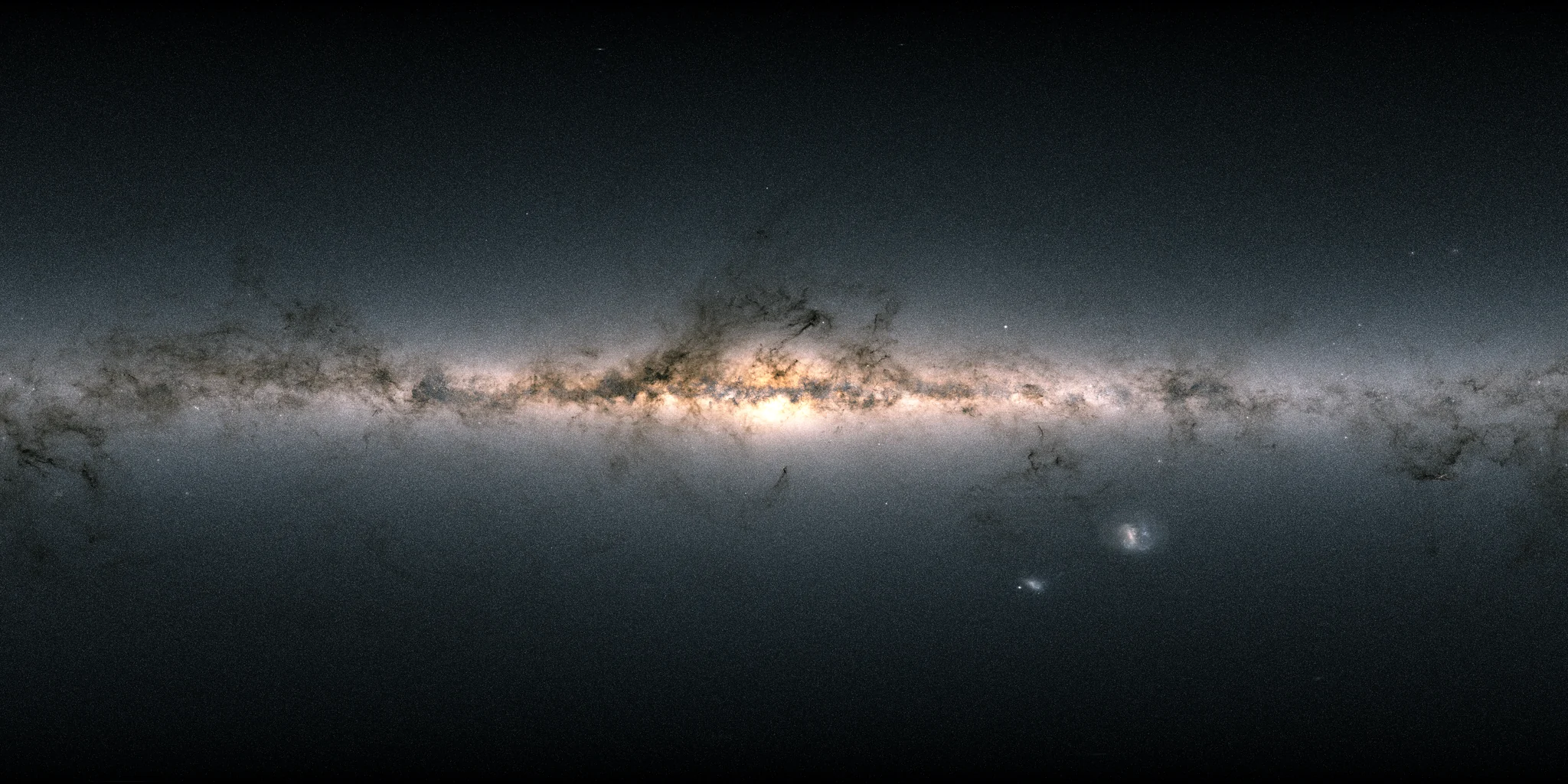
Milky Way: Gaia EDR3 observed all-sky colour map, ESA/Gaia/DPAC; acknowledgement: A. Moitinho. Adapted under CC BY-SA 3.0 IGO: reduced resolution, WebP compression, and dimmed for display. The map is aligned with the stellar coordinate frame and shown as a distant angular backdrop. Download the adapted map.
The sky includes all 88 constellations; Serpens appears in two parts. Ten figure stars without usable catalogue distances and their adjoining lines are omitted. Labels appear where space permits as you turn the view.
The starfighter is a playful, TIE Avenger–inspired illustration. Photographs are placed by region. The shaded areas mark the 35 countries and territories I’ve visited, from my travel record updated in September 2026. More detail is in Reizentraj.
The static sky uses the D3 Celestial catalogue.